On November 12, Nvidia announced Jensen Huang’s resignation and appointed CFO Colette Kress interim CEO while its board searches for a permanent successor. That transition raises a management question with implications well beyond Nvidia: what happens when an organization built around an exceptional founder must operate without him?
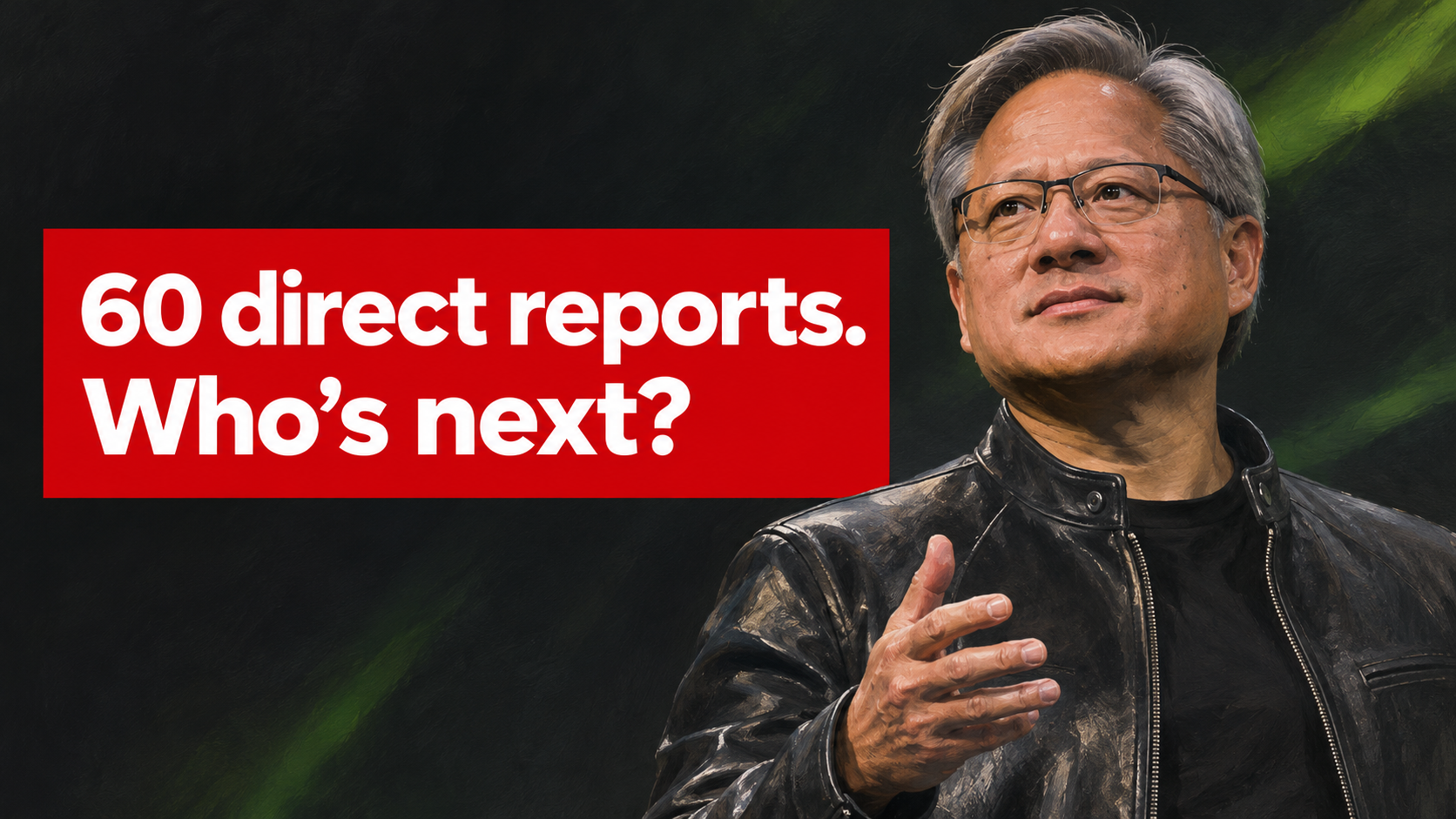
At Stripe Sessions in 2024, Huang described having 60 direct reports. Asked whether his executives should have similarly wide spans, he cautioned: “I don’t think that that’s scalable downward.”
That distinction matters. A structure that works for one extraordinary leader may be difficult for another to inherit. And as AI promises to expand how much executives can oversee, we should ask whether greater individual capacity also builds leadership capacity across the business.
Why management spans were narrow
Traditional recommendations for five or six direct reports weren’t simply products of an era without dashboards. They reflected the difficulty of coordinating people whose work depends on one another.
In 1933, management theorist V. A. Graicunas examined how supervisory relationships multiply as a team grows. Lyndall Urwick subsequently argued for narrow spans when subordinates’ work interlocked. These were prescriptions, not evidence that every company operated at a fixed ratio for decades.
Consider a simpler illustration: five people have ten possible pairwise relationships; ten have 45. A manager doesn’t personally handle every interaction, but adding people can create coordination demands faster than headcount grows.
Narrow spans have costs, too. Herbert Simon pointed out in 1946 that limiting direct reports can require additional management layers, complicating communication. The problem has always involved a tradeoff between a manager’s capacity and the organization’s complexity.
When wider spans work
There is no universally correct number.
McKinsey’s research distinguishes between managers who perform substantial individual work and those overseeing standardized activities performed by independent teams. Its suggested spans range from three to five for a “player/coach” to more than fifteen for a “coordinator.”
The relevant questions concern the work: How varied is it? How experienced are the people? How much coaching do they need? How many decisions require judgment across functions?
Sixty experienced specialists with meaningful decision authority present a different challenge from sixty people waiting for approval.
What AI changes—and what it doesn’t
AI can reduce the effort required to collect updates, synthesize information, and identify exceptions. That creates a plausible case for wider management spans. It does not automatically resolve disagreements, develop judgment, or establish who has authority to act.
Research predating generative AI offers a useful distinction. Bloom and colleagues found that technologies improving access to information were associated with greater autonomy and wider spans, while technologies improving communication were associated with more centralized decisions.
The implication is important: technology can help employees solve problems themselves, or make it easier to send those problems upstairs.
An AI system that helps a team make sound decisions could reduce its dependence on the founder. A system that delivers every exception to the founder’s dashboard could reinforce that dependence.
The question is what happens to decision-making authority when information becomes cheaper.
Where successors get developed
Nvidia’s interim appointment does not establish that its board lacked a succession plan. Nor does having 60 direct reports prove that Huang’s structure caused a succession gap.
But the structure raises a legitimate question: who gets practice making enterprise-wide tradeoffs?
Future CEOs need experience allocating resources across competing priorities, resolving disagreements among functions, and taking responsibility for decisions that affect the whole business. Access to the founder’s thinking is valuable. It is different from owning those decisions.
For boards and business owners considering flatter organizations, three questions deserve attention:
• Which decisions can people make without the leader’s intervention?
• Does AI reduce dependence on the leader, or simply increase the leader’s visibility?
• Who is gaining experience making consequential tradeoffs across the business?
In the selection economy, choosing an operating structure also means choosing where judgment develops. AI may help one person oversee more. The more durable achievement is building a business in which more people are prepared to lead.
Are we building organizations that can do more—or organizations that depend on one person to do too much?
What this means for your business
Where could AI give your team more independence—and give you more room to lead?
I help founders and business owners work through those decisions, then build the tools and systems to put them into practice. If you’re rethinking how your business gets work done, let’s talk.
Let’s talk →Sources
1. Nvidia: CEO transition announcement, November 12, 2026
2. Stripe Sessions 2024: A conversation with Nvidia’s Jensen Huang
3. A History of the Span of Management
4. Herbert Simon: The Proverbs of Administration, 1946
5. McKinsey: How to identify the right spans of control for your organization
How this article was developed
I developed the question and editorial direction, then worked with OpenAI’s ChatGPT/Codex to locate and compare sources, examine competing explanations, and draft the article. The research draws on company disclosures, an original interview, academic studies, and management research linked above. The argument about succession is an interpretation, not a demonstrated causal finding about Nvidia.